Waking at 3 am in perimenopause: what to do when it happens
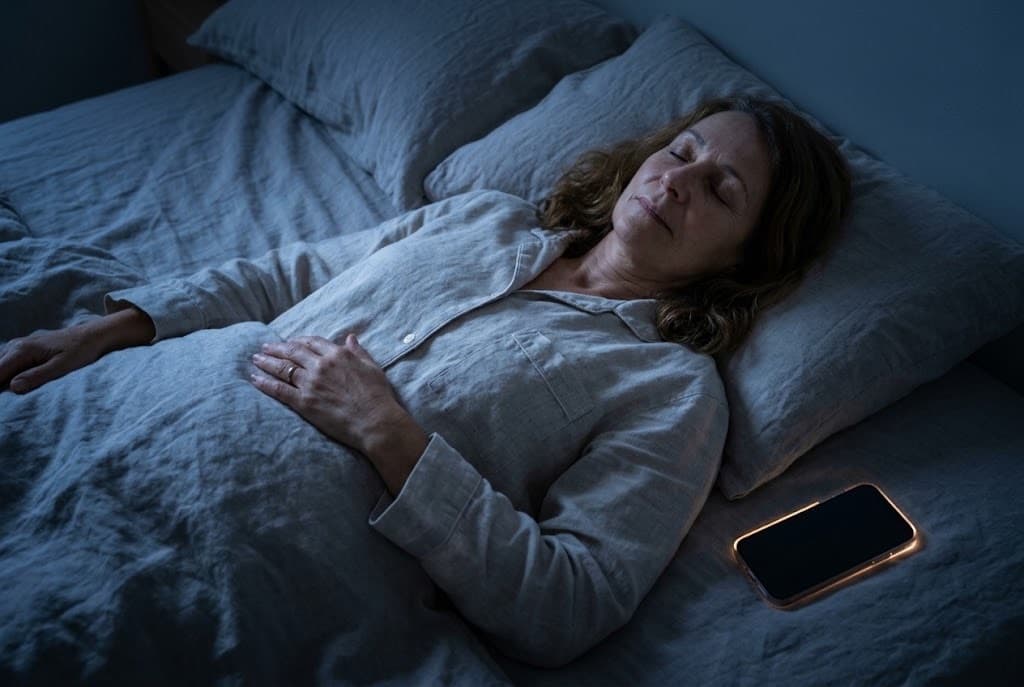
It’s 3:07. The house is quiet.
The body is tired. The heart is already going.
Not a noise. Not a dream. Just awake, all at once.
Why 3 am, why now
Nearly half of women in late perimenopause report trouble sleeping.
Progesterone helps hold sleep, and in perimenopause it falls.
Most hot flashes at night come with a waking.
Where she once turned over, now she surfaces. And the mind treats it as morning.
It’s not a sleep problem. It’s an alarm problem.
What to do when it happens
- Leave the light off. Room light at night shuts off melatonin, the sleep hormone.
- Turn the clock away. Knowing it’s 3:07 only starts the sums.
- Breathe out longer than in. In for 4, hold for 2, out for 7. Slow breathing calms a racing body.
- Still awake after 10 minutes? Get up, somewhere dim, and come back when the eyes are heavy.
Free. No account. Ten minutes.
One tap. The screen stays dark. A calm voice. A long, slow breath out.
It ends with the get-up step.
Try the 3 am breath nowWhere the get-up step comes from
Doctors’ first choice for insomnia is CBT-I, not pills.
Getting up when sleep won’t come is one of its steps. It’s in the free breath above.
What it won’t do
It won’t stop perimenopause. Nobody can. It gives 3 am a plan.
Not a pill. Not a hormone. Alongside your doctor.
Chest pain or fainting at night: call a doctor, not an app.
Want a plan for every night, not just this one?
Answer a 2-minute quiz. The answers build the plan.
Build my 3 am planNot medical advice. Alongside your doctor, never instead.
Where this comes from
- SWAN study: sleep trouble in midlife women, Menopause, 2003
- Progesterone and night waking, Psychoneuroendocrinology, 2008
- Hot flashes and waking in perimenopause, Fertility and Sterility, 2014
- Room light at night and melatonin, J Clin Endocrinol Metab, 2011
- Slow breathing, a review of 15 studies, Frontiers in Human Neuroscience, 2018
- CBT-I first for insomnia, American College of Physicians, 2016